
Selected Work · PACT — Purchasing & Approvals
Every request.A clear next step.
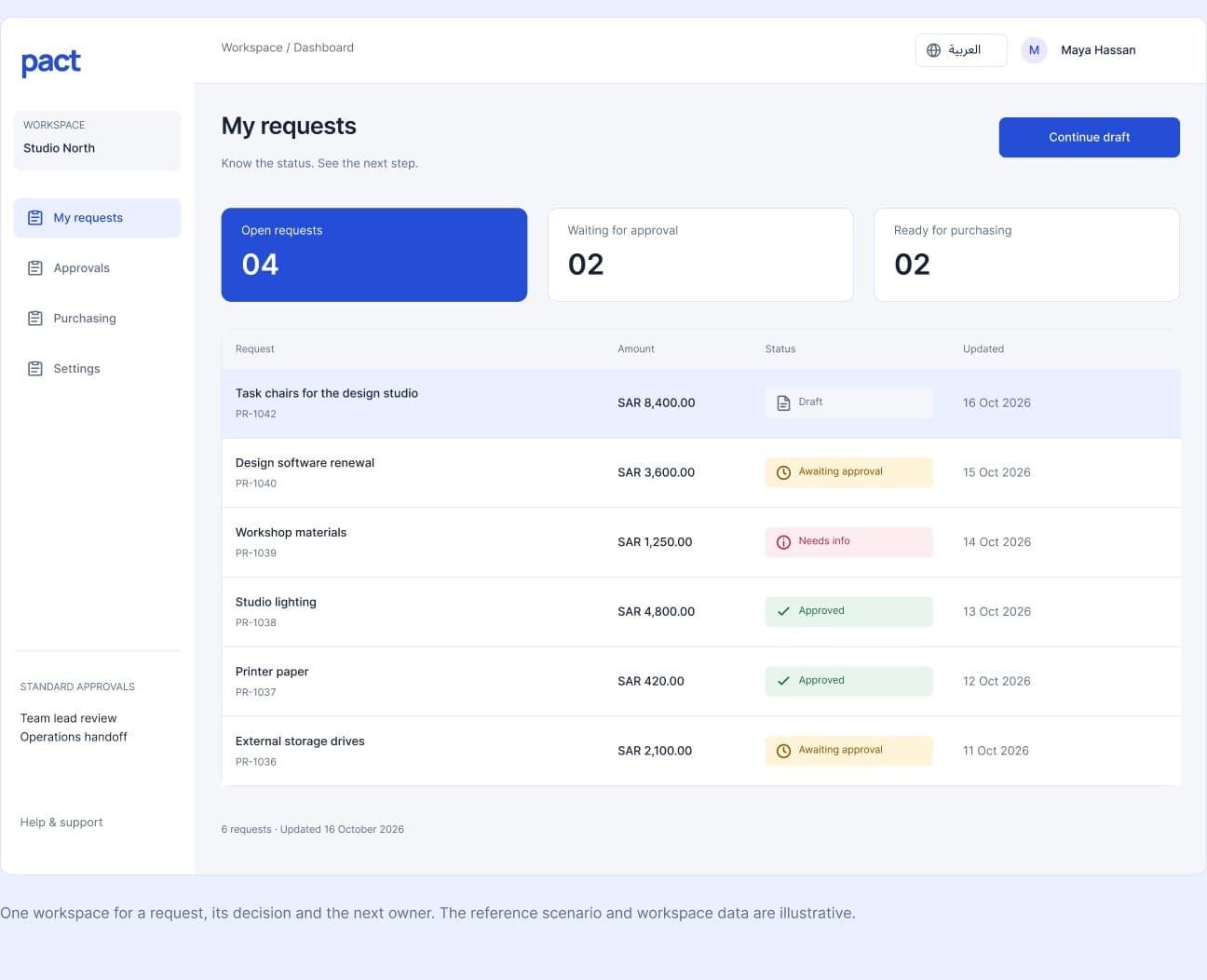
A bilingual product experience for purchasing requests, decisions, and operations handoffs: clear status, named ownership, and native RTL symmetry.
- Client
- PACT
- Sector
- B2B Operations Software
- Our Role
- UX Strategy · Product UI · Prototype
- Languages
- English + Arabic · LTR + RTL
[01]The Challenge
Move the request.Keep the context.
Purchasing involves people with fundamentally different responsibilities: requesters who need gear quickly, managers who evaluate budget, and operations who execute supplier orders.
The design challenge is to give each role exactly the right information while preserving one continuous, untruncated request record across every handoff.
What happens next?
Prepare a complete request, understand the approval route, and track who owns the next step without ambiguity.
Can I decide confidently?
Review the reason, amount, supplier quote, and delivery context together. Request changes without losing the record.
Is the handoff complete?
Receive an approved request with supplier, quote, delivery date, and a named purchasing owner ready for immediate fulfillment.
[02]Evidence Before Assumptions
Define what we know.Make questions visible.
The business brief establishes three roles and bilingual access. Role needs are working hypotheses; the research plan is designed to test them rather than present them as findings.
Clarity depends on ownership.
A written status alone may not be enough. The interface therefore names the next reviewer and maintains an activity audit trail so teams always know who holds the baton.
Follow a recent purchase.
Ask each role to walk through its last purchase request: where the quote lived, what delayed the decision, and how the final handoff was confirmed between English and Arabic contexts.
[03]The Journey
One request. Three responsibilities.
Map the information that must survive each transition. This keeps the interface focused on the task and exposes the assumptions to validate with users.
Build a complete request
Owner: Requester
Inputs: Title, cost center, supplier, delivery date, item and quote.
Risk: Incomplete context causes back-and-forth follow-up.
Design response: Persistent summary and explicit review step before submission.
Know who has the next step
Owner: Requester
Inputs: Submitted record routes directly to Omar Khalid.
Risk: Status alone may not explain ownership or accountability.
Design response: Named reviewer and timestamped audit activity trail.
Approve with context
Owner: Approver
Inputs: Business reason, amount, quote and requested date.
Risk: Missing delivery detail blocks a confident decision.
Design response: Request changes without discarding or resetting the record.
Receive an approved package
Owner: Operations
Inputs: Approved record, supplier quote, delivery context and owner.
Risk: Fragmented information complicates purchase ordering.
Design response: One centralized queue with a complete handoff summary.
[04]Information Architecture
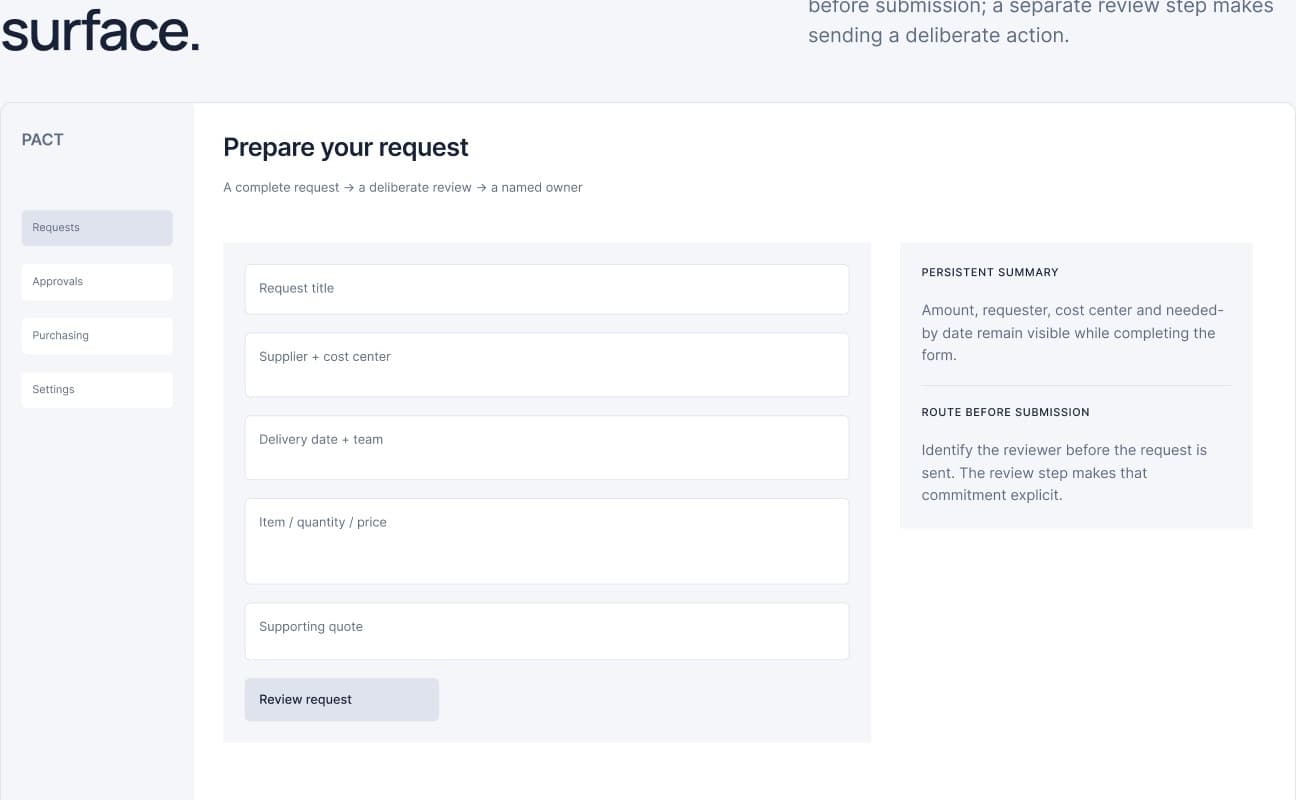
Structure before surface.
The request form pairs a focused main form column with a persistent summary. Reviewer ownership appears before submission; a separate review step makes sending a deliberate commitment.
[05]The Requester Experience
Prepare once.Review with confidence.
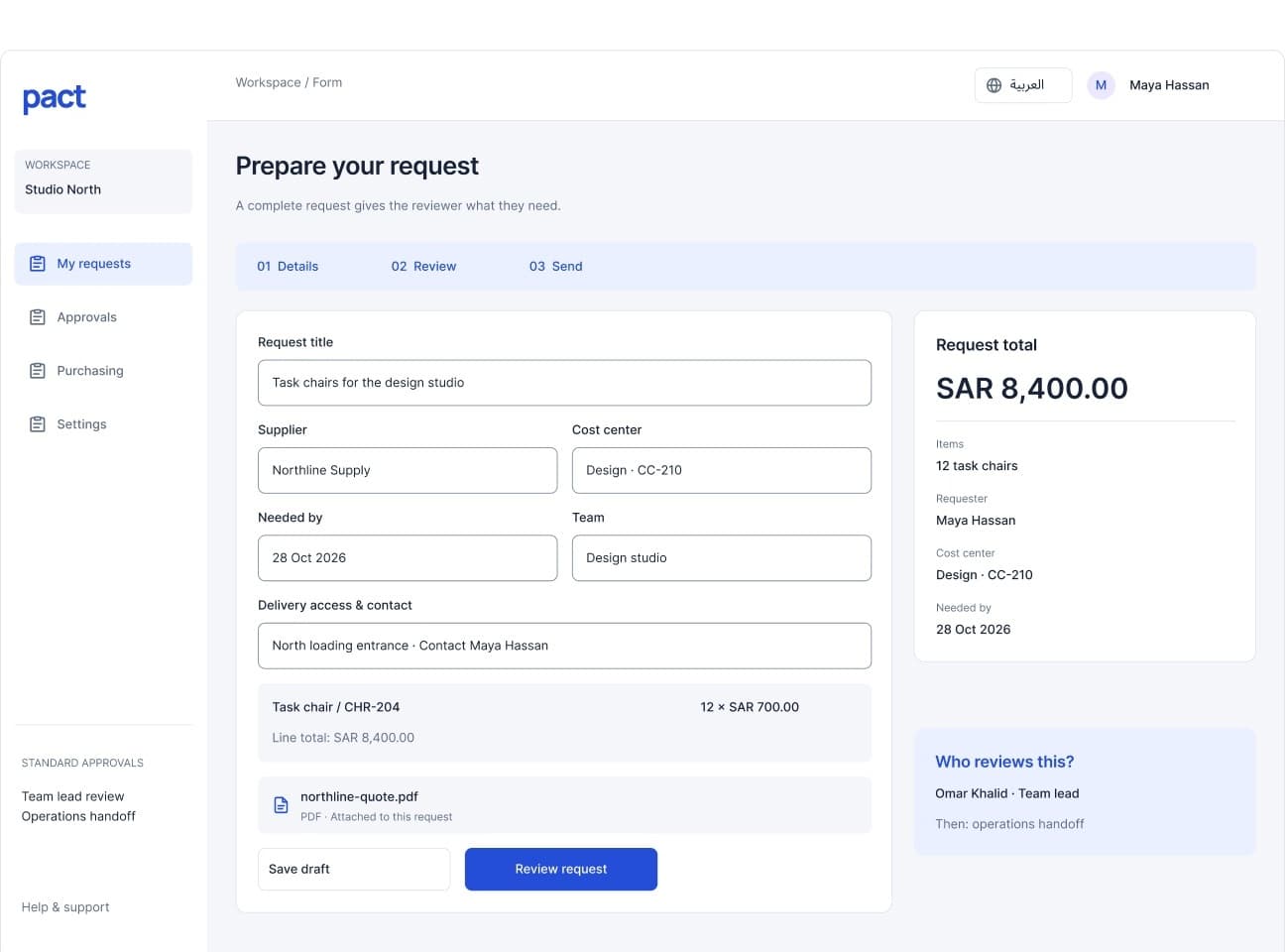
Visible labels, an attached supplier quote, and a persistent live total make the record understandable before it reaches another person. Saving a draft remains a clear secondary action.
Make routing explicit.
Cost center and team travel with the request. The summary names the reviewer before the request is submitted.
Keep review separate.
Preparing and sending are different psychological moments. The review screen surfaces total, quote, and route together.
Preserve the record.
The same PR-1042 identifier, twelve chairs, and SAR 8,400 total continue seamlessly through approval and purchasing queues.
[06]Decision & Handoff
Decide with context.Hand over with clarity.
The approver sees the reason, total, quote, and requested date together. Approval changes the request state; operations receives the same record with a named owner.
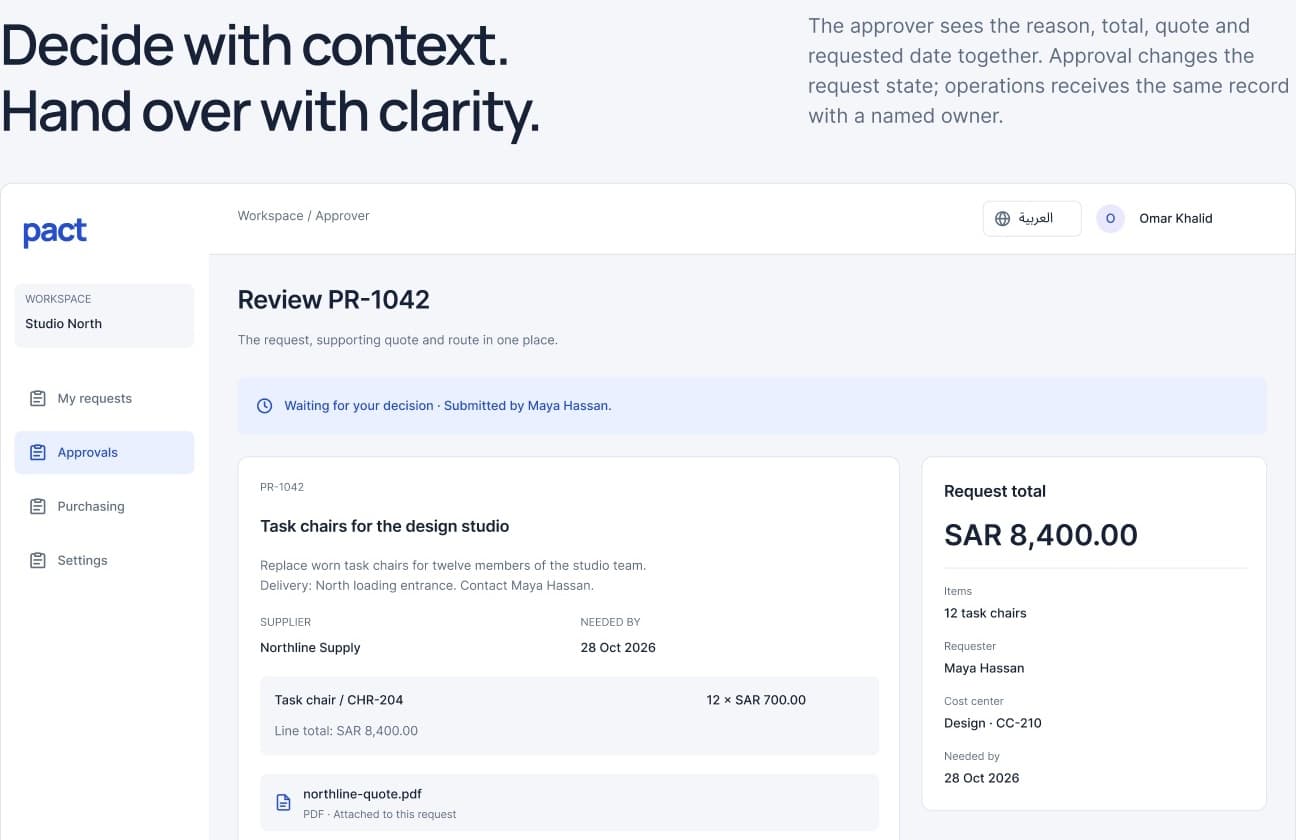
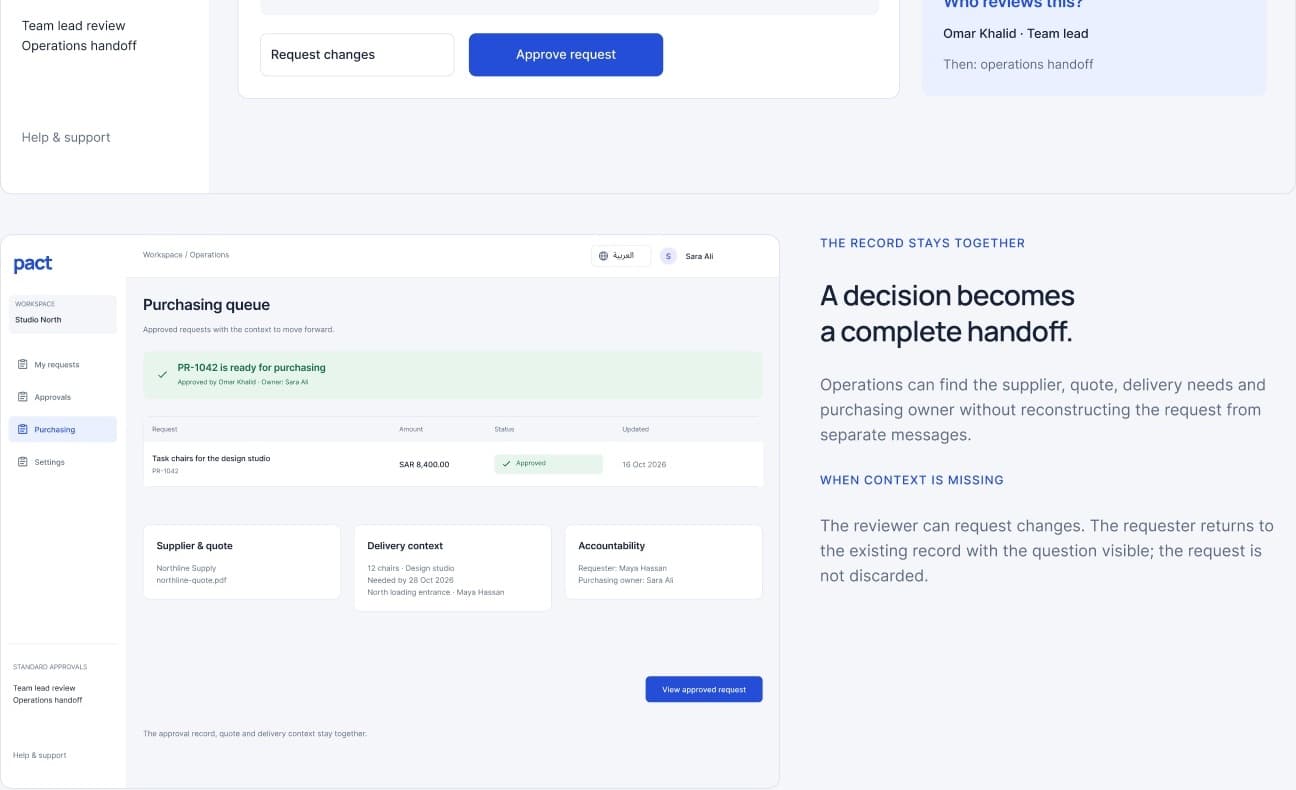
A decision becomes a complete handoff.
Operations can find the supplier, quote, delivery needs, and purchasing owner without reconstructing the request from fragmented emails or chat messages.
Clear feedback without discarding.
The reviewer can request changes. The requester returns to the existing record with the exact question visible; the draft is never discarded.
07 / Arabic — Designed In Its Own Direction
The same task.A native reading order.
وضوح في كل موافقة.
Arabic is not an afterthought or an auto-translation. It is a complete, first-class product experience with native RTL navigation, Saudi date/currency standards, and typographic breathing room.
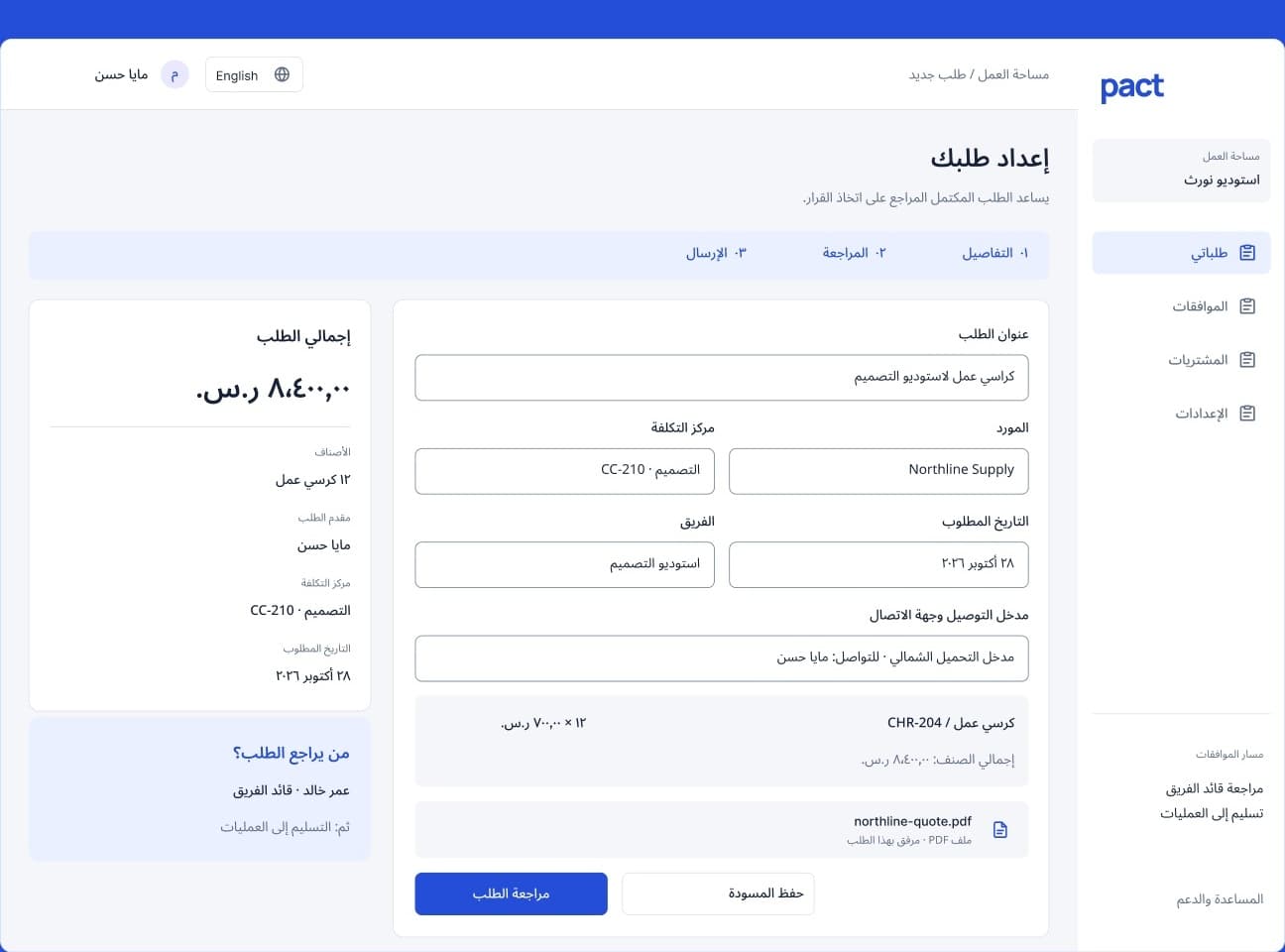
Modern Standard Arabic · Saudi date and currency formatting · Noto Sans Arabic · Same request and workflow state
[08]Localization Beyond Translation
Mirror the structure.Respect the content.
Layout direction and content direction are separate decisions. The design mirrors navigation and action order while preserving the integrity of identifiers, filenames, and supplier names.
| Design Rule | English (LTR) | العربية (RTL) |
|---|---|---|
| Reading order | Left navigation, first table column on the left | التنقل على اليمين، والعمود الأول على اليمين |
| Currency formatting | SAR 8,400.00 | ٨,٤٠٠,٠٠ ر.س. |
| Date formatting | 28 Oct 2026 | ٢٨ أكتوبر ٢٠٢٦ |
| Stable identifier | PR-1042 | PR-1042 (Latin alphanumeric preserved) |
| Attached filename | northline-quote.pdf | northline-quote.pdf (Direct file integrity) |
| Workflow status chip | Awaiting approval | بانتظار الموافقة |
Use logical relationships.
Place leading content on the reading-start edge. Mirror directional arrows and action order; keep brand artwork and non-directional icons unchanged.
Give Arabic room to read.
Noto Sans Arabic uses its own line-height scale and zero tracking. Components allow longer labels without squeezing or truncating the meaning.
Keep one source of truth.
Format amounts and dates from data for each locale. Keep Latin references in their own directional run and preserve request context when changing language.
[09]Accessibility As A Design Input
Make the state visible.Make the action clear.
Focus, errors, and status changes need more than subtle color tints. The component specifications define explicit labels, written feedback, readable contrast, and generous primary action targets.
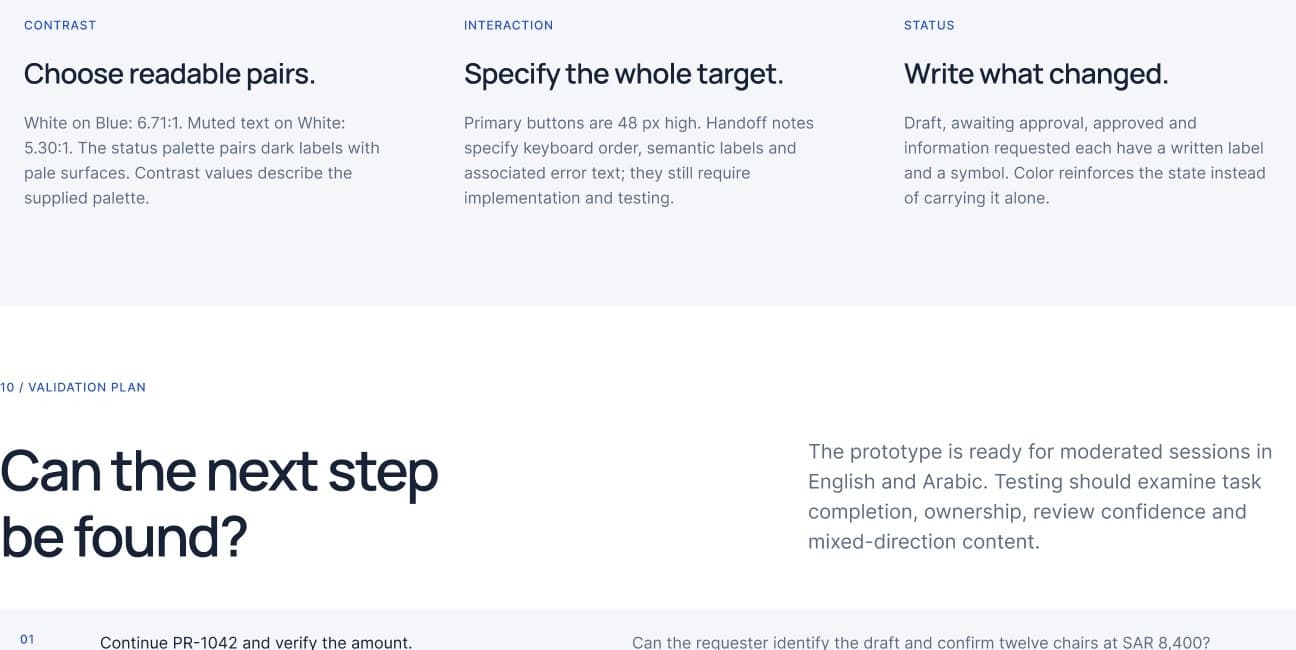
Choose readable pairs.
White on Blue: 6.71:1. Muted text on White: 5.30:1. The status palette pairs dark labels with pale surfaces for effortless readability.
Specify the whole target.
Primary buttons are 48 px high. Handoff notes specify logical keyboard order, semantic aria-labels, and associated error text.
Write what changed.
Draft, awaiting approval, approved, and info requested each carry a written label and icon. Color reinforces state instead of carrying it alone.
[10]Validation Plan
Can the next step be found?
The prototype was prepared for moderated usability testing in English and Arabic to examine task completion, ownership recognition, review confidence, and mixed-direction interpretation.
[11]A Usable Design Handoff
From screensto implementation.
Localized components, typography styles, and design tokens support the interface. The handoff documents the interactive states and behaviors that static artboards cannot convey.
Components with context.
English and Arabic buttons, inputs, navigation, request rows, and status chips with focus, validation, and disabled treatments included as reusable assets.
Direction is explicit.
Use lang and dir at the application boundary, logical spacing, and content-aware directional isolation to preserve workflow state across language switches.
Behavior is specified.
Headings, table headers, form labels, errors, keyboard tab order, and screen-reader announcements are documented for frontend parity.
PACT / Product Design + RTL Localization
One shared record. Every role aligned.
طلب واحد. وضوح لكل دور.
A coherent purchasing platform designed to make requests, decisions, and operations handoffs completely understandable — in both directions.
Next case study
Aura Threads E-commerce Storefront
An eco-conscious high-street brand's storefront, with the energy of a fashion magazine and checkout built for conversion.